

For many women runners, aches and pains like IT band syndrome, runner’s knee, and shin splints are not always caused by simply “running too much.” Often, the problem begins higher up at the hips. Your hips and glutes act as the stabilizing powerhouse for your stride, helping control alignment, absorb impact, and keep your knees and lower legs moving efficiently with every step. When those muscles are weak or not firing properly, other areas compensate, increasing stress on the knees, shins, and IT band. Research has shown female runners with IT band syndrome often demonstrate weaker hip abductor strength and altered hip mechanics compared to uninjured runners¹.
Women may be especially vulnerable because of natural biomechanical differences, including wider pelvis structure and greater hip motion during running. Studies have found female runners tend to exhibit increased hip adduction and internal rotation, which are movement patterns associated with higher IT band strain and knee stress (1). This is why hip stability matters so much. Strong, stable hips help prevent the inward collapse of the knee that commonly contributes to overuse injuries. They also improve running efficiency by allowing your body to transfer force more effectively instead of wasting energy trying to stabilize each stride.
Glute activation is equally important. Many runners technically have strong glutes but struggle to recruit them properly while running. When the glutes are not engaging well, smaller muscles like the hip flexors, TFL, and IT band often take over stabilization duties they were never designed to handle alone. Over time, this compensation can contribute to lateral knee pain, tight hips, shin discomfort, and inefficient movement patterns. In an article about the most common injuries among female runners, Runner’s World recently highlighted weak hips and glutes as a major contributor to patellofemoral pain².
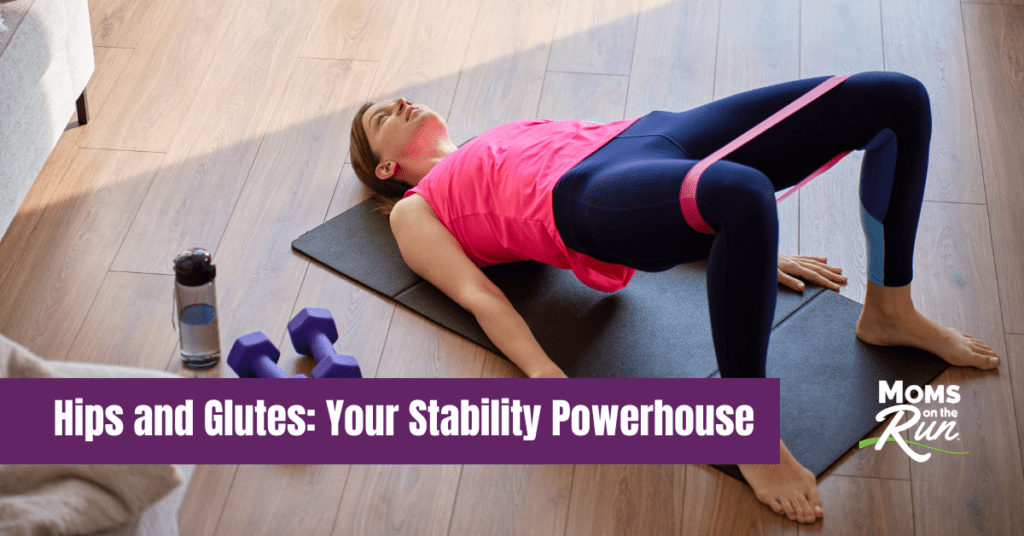
The good news is that hip stability can be trained. Exercises like clamshells, monster walks, lateral band walks, single-leg deadlifts, bridges, split squats, and step-ups can dramatically improve pelvic control and glute engagement. Single-leg exercises are especially valuable because running itself is essentially a series of single-leg movements. Consistency matters more than intensity. Even two short strength sessions per week can make a meaningful difference in injury prevention and performance.
Strong hips do more than reduce injury risk. They also help you run stronger and more efficiently. Better stability can improve posture, create a more powerful push-off, reduce wasted energy, and support endurance late in a run when fatigue sets in. For female runners especially, glute and hip strength is not “extra credit” training. It is foundational. So try adding some new stability exercises to your routine this week; when your hips are stable and your glutes are doing their job, everything down the chain tends to work better too!
Sources:
¹Science Direct (link to this: https://www.sciencedirect.com/science/article/abs/pii/S0966636223000334
²Runners World (link to this: https://www.runnersworld.com/beginner/a71220616/two-most-common-beginner-runner-injuries/