

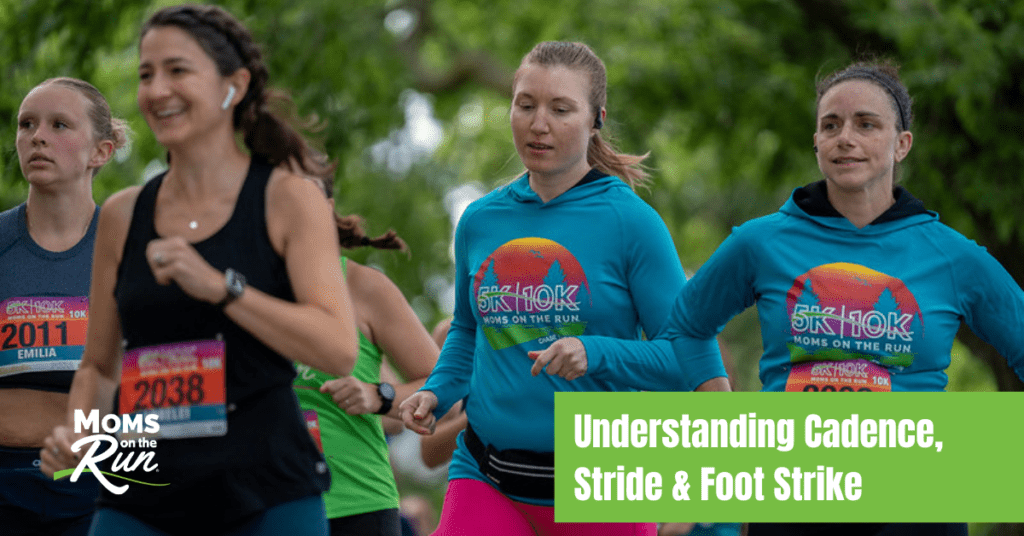
Wouldn’t it be nice if the only thing runners had to think about was “just put one foot in front of the other!” In reality, the mechanics behind each stride are surprisingly complex, and understanding these can help us move more efficiently while reducing unnecessary stress on our joints and soft tissues. Today we will focus on some key elements of these running biomechanics: cadence, stride length, foot strike and posture. Making small adjustments in these areas can make a significant difference in performance, comfort, and long-term injury prevention.
Cadence, or the number of steps you take per minute, is one of the most influential factors in running form. A slightly higher cadence generally leads to shorter, quicker steps, which can help reduce the impact forces traveling through the legs. Overstriding (when your foot lands too far in front of your body) is often linked to a lower cadence and can increase braking forces on the joints. More on that below.
You will often hear a recommended cadence of 180 foot strikes per minute, but the ideal number varies by individual, and additional elements of one’s fitness and training come into play here. Rather than a goal number, focus on improving cadence by even 5% at a time. Runners can become more efficient and decrease stress on the knees and hips as they increase this number.
Shortening stride length is one of the most direct ways to improve cadence. Stride length works alongside cadence to determine your overall speed. While it might seem intuitive to run faster by taking longer strides, overextending can actually be counterproductive. An optimal stride length allows your foot to land closer to your center of mass, reducing impact and improving forward momentum. Efficient runners focus on pushing off the ground behind them rather than reaching forward, which helps maintain a smoother and more natural gait cycle.
Foot strike is another consideration, and this refers to the part of the foot that first makes contact with the ground. This varies greatly from runner to runner, with heel striking, midfoot and forefoot striking all being common patterns. While most will advocate against heel striking, there is no single “perfect” foot strike that all runners and biomechanics experts agree on. Where your foot lands relative to your body matters more than which part hits first. Landing with your foot too far ahead is the overstriding mentioned above. Once you’ve mastered a centered landing to distribute the load evenly and better support shock absorption, IF you are a heel-striker, work on learning to land more midfoot. There are online resources to support this effort including some effective drills you can do to work on this.
Lastly, let’s discuss posture, which ties all of these elements together. A tall, relaxed posture with a slight forward lean from the ankles allows gravity to assist with forward movement. Keeping the head up, shoulders relaxed, and arms swinging naturally helps maintain balance and rhythm. Poor posture — such as slouching or leaning forward from the waist — can disrupt alignment and lead to compensations that place extra strain on the lower back, hips, and legs.
Runners who understand and fine-tune their cadence, stride length, foot strike, and posture can create a more efficient and sustainable running style. The goal isn’t to chase perfection, but to make small, intentional improvements that reduce stress on the body. Over time, these adjustments can lead to smoother runs, better performance, and fewer interruptions from injury. Sounds like a win-win!