


Have you ever wondered how heart rate training works?
While pace tells you how fast you’re going, your heart rate tells you how hard your body is working. And when you learn to use it, your workouts can become more intentional, healthier and more effective. In this article, you’ll learn what heart rate training is, the real science behind it, the pros and cons, and how to start.
What Is Heart Rate Training?
First and foremost, heart-rate training means monitoring your heart’s beats per minute (BPM) during exercise and using that data to guide how hard you train. Instead of running by “feel” or by pace alone, you train based on how your cardiovascular system responds in real time.
Specifically, your training is divided into five heart rate zones. Each zone is associated with a percentage of your maximum heart rate. Your maximum heart rate is the fastest your heart can beat during exercise. These zones help you target different types of adaptations like endurance, strength, speed and recovery.
For most runners, especially beginners and those juggling life responsibilities, Zone 2 training is the foundation of smart conditioning. Zone 2 is about 60-70% of your max heart rate.
“Historically, Moms on the Run has trained using rating of perceived exertion,” shares Karissa Johnson, CEO of Moms on the Run. “In Spring of 2026, we’ll begin incorporating heart rate training zones in our intermediate training schedules.”

Why DOES Heart Rate Training Work? The Science
Heart rate training is grounded in how the body adapts to exercise. Here’s why it can be effective:
Build a Strong Aerobic Base
When you train in Zone 2, your body improves its ability to use oxygen efficiently, increases the number of small blood vessels around your muscles, and enhances the function of mitochondria. Mitochondria are the powerhouses inside cells that generate energy.[1]
As a result, you burn fat more efficiently and can sustain activity longer. One review on endurance physiology confirms the value of low- to moderate-intensity aerobic work for metabolic and cardiovascular fitness.[2]
Endurance Gains Over Time
Instead of always pushing hard, longer low-effort sessions help your body adapt so you can one day run faster at the same heart rate. That’s because your body becomes more efficient at fueling long efforts through oxygen-based metabolism.
In fact, some coaches suggest dedicating 60-75% of your training time to Zone 2 to build a strong endurance base. Elite and recreational athletes alike can benefit from this type of training.[3]
Better Recovery and Reduced Injury Risk
Because Zone 2 and low heart-rate work are less taxing on your muscles and joints, you recover quicker and reduce overuse injuries that often accompany constant hard running.
WHERE HEART RATE TRAINING FALLS SHORT
One important caution with heart rate training is that the commonly used formula “220 minus your age” is just a rough estimate. Some experts say up to 20% of the population does not fall within a “normal” window of expected heart rate zones for their age. Studies have found that this age-predicted equation can vary by about ±10-12 beats per minute from a person’s true maximum heart rate.[4]
Because of that high variability, relying on this formula alone can lead to inaccurate training zones. This means you might train too easy and miss out on key adaptations or train too hard and risk fatigue or injury. Instead, it’s best to use 220-age as nothing more than a starting point, and to refine your zones over time using actual measured efforts, perceived effort, the talk test and trends in your own training data.
The Pros and Cons
Like all tools, heart rate training has benefits and limitations. Knowing both helps you use it wisely.

Pros
- More personalized training – Your heart rate reflects how your body is handling the workout, not just how fast you’re moving.
- Balanced workouts – You avoid over-training on “easy” days and under-training on “hard” days.
- Better long-term endurance – Because most training stays aerobic, you build a strong base that lasts.
Cons
- Heart rate fluctuates – Caffeine, hydration, lack of sleep, stress and weather can temporarily raise your heart rate unrelated to effort.
- Device dependency – To do accurate heart-rate training, you need a monitor or GPS watch.
- Data isn’t everything – Training by numbers alone doesn’t replace listening to your body.
Heart Rate Training for Beginners: How to Start
1. Know Your Max Heart Rate
The best way to determine your heart rate zones is to conduct personalized zone testing in a lab. In the Twin Cities, Human Powered Health offers this service.
Your personal GPS watch MAY provide you with an accurate picture of your zones. However, this can vary according to how fine-tuned your technology is.
As previously mentioned, people use the standard formula of 220 minus their age to determine their estimated max heart rate. Remember that this is not accurate for everyone.
2. Get Comfortable With the “Talk Test”
If math sounds overwhelming at first, start with the talk test. Zone 2 training feels steady and comfortable. You should be able to chat in short sentences without gasping. This simple tool is especially helpful for beginners before you dive into tech.
3. Start With Mostly Easy Runs
Begin by keeping most of your runs in Zone 2. As you build confidence and fitness, you can gradually add one or two harder efforts per week. Most plans still keep the majority of mileage aerobic.
4. Track Progress
Over weeks and months, you’ll notice:
- Your resting heart rate goes down (sign of improved fitness).
- Your pace at a given heart rate improves.
Both are great indicators you’re becoming a stronger runner.
Final Thoughts: Run With Heart (and Intention)
At its core, heart rate training helps you understand effort so you can train smarter, build endurance and recover well. While formulas offer a starting point, real progress comes from combining data with body awareness and consistency.
“As we begin incorporating heart rate training zones into our programming, our goal is to help women train smarter and more confidently,” explains Karissa. “It’s most important to train with intention. Let your body and heart guide the way.”
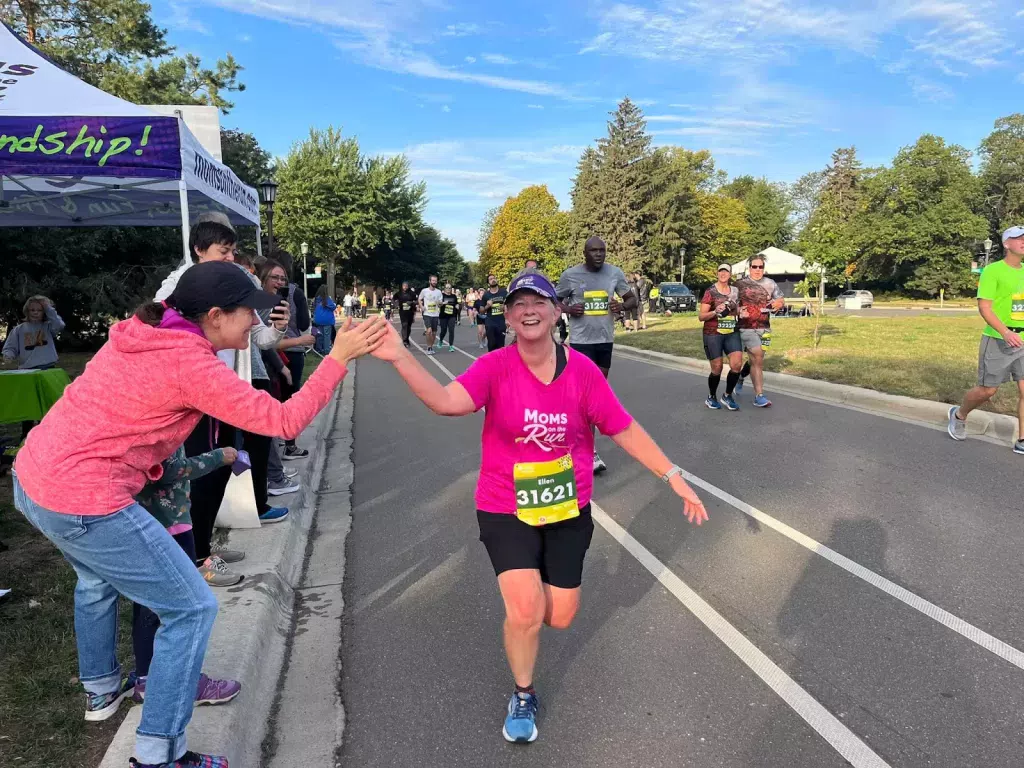
Learn more about Moms on the Run spring class offerings by finding a location near you.
[1] https://health.clevelandclinic.org/zone-2-cardio
[2] https://sems-journal.ch/15955
[3] https://www.trainingpeaks.com/blog/zone-2-training-for-endurance-athletes
[4] https://pmc.ncbi.nlm.nih.gov/articles/PMC7523886/