

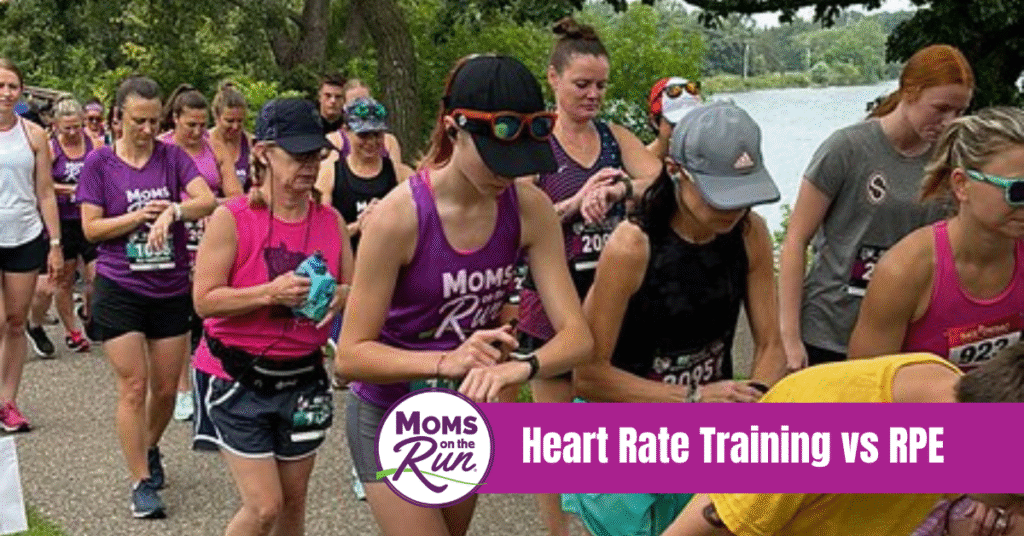
This spring at Moms on the Run, we’re introducing concepts related to heart rate zone training . And then, you get to decide what training method works best for you!
Heart rate zone training has increased in popularity in recent years due to how accessible it has become. Fitness watches and other heart rate monitoring devices have provided the technology. Now we want to learn how to use it.
It’s wonderful to see fitness enthusiasts become more in tune to their unique physiology and adapt their workouts to meet their goals. But it can also be concerning when consumers are using “one size fits all” formulas that may not actually align with their bodies. More on that in a bit!
Rating of Perceived Exertion
Moms on the Run has traditionally trained using Rating of Perceived Exertion (RPE). We advise our participants at what level on a 1-10 scale they should be training at, for each segment of our workouts. That’s because intensity matters! We recommend participants complete 80% of workouts at an easy-to-moderate intensity and 20% at a higher effort. Yet, that 20% IS important.
There are health benefits and physiological reasons why you want to train in ways that utilize and improve all of your body’s energy systems. This means you do want to push yourself to challenging levels at times, in that 6-10 range.
But the majority of the time, easy-paced workouts are key to improving our general cardiovascular fitness and aerobic capacity. Runners too often runners neglect these, assuming “harder is better.” For more info on RPE training and why it may be more ideal at times than overdependence on technology, see this article. The article provides a thorough discussion from our friends at Trailrunner Magazine.
Heart Rate Zone Training Defined
Heart Rate Zone Training takes some of the “guess” out of perceived exertion. It helps us to train at a certain heart rate which can tell us how hard our body is actually working.
Your intensity is calculated as a percentage of your max heart rate, and a heart rate range is assigned a zone category. For example, if your max HR is 180, when you train between 126-142, this is 70-79% of your max and considered Zone 3.
The Problem with Standard Heart Rate Zone Training
The issue comes into play when one tries to do zone training using standard formulas rather than knowing their actual personal zones. Some experts say up to 20% of the population does not fall within a “normal” window of expected heart rate zones for their age. This can be related to genetics and other factors. So please think twice before using “220-age” or similar formulas to calculate.
Your personal GPS watch MAY provide you an accurate picture of your zones. However, this can vary according to how fine-tuned your technology is. It is also dependent on things like how long you have worn the watch and how much you have pushed your intensity while wearing it, such that it actually can know what your max heart rate is. One way to see how accurate your watch is, is to perform a personal field test. However, it is best to conduct personalized zone testing in a lab. We’re happy to refer you to the professionals at Human Powered Health (if you’re in the Twin Cities) or select other locations in your area.
Heart Rate Training Zones in Moms on the Run Classes
Moms on the Run will continue to offer our training via RPE this spring and summer, while also correlating each RPE to heart rate training zones in our intermediate training schedules. Our workouts are expertly designed by an Olympian, our very own Fitness Director Carrie Tollefson! She takes great care writes balanced workouts to incorporate the right mix of your various levels of exertion or “zones.”
We’re looking forward to another great season of training hard but training SMART, while incorporating Fitness, Fun & Friendship into the mix! Happy Spring Training everyone!